Every number on the site is a query against one checklist database — not hand-typed, estimated, or AI-generated. This page defines each metric so a figure on a product page always reconciles with the team and player pages inside it.
Cosmic Chrome remains the featured product. Update Series, Museum Collection and Allen & Ginter X use their own supplied Topps checklists and odds sheets. Published odds apply to a family or parallel, not an individual subject. A listed subject is not guaranteed to appear in every advertised parallel.
Checklist PDF · Nine-format odds PDF · Supplied parallel chart · Topps Hobby configuration · Topps Jumbo configuration
The base checklist has 350 designs; multi-player subjects share their card identity. Variations use their own published subject subsets. World Baseball Classic Highlights browse by country without MLB divisions. Buyback redemptions retain the full collectible description; unnumbered redemption entries retain their source order. Repeated Fanatics redemption subjects remain separate entries. The gift-redemption Fanatics cell prints 1:-401,280; it is retained in source records and omitted from probability calculations. Hobby and Jumbo estimates use 20 and 10 regular packs, respectively, excluding bonus packs.
Checklist PDF · Hobby odds PDF · Topps box guide · Topps collector guide
The checklist contains 1,317 designs. Six repeated Museum Memorabilia odds rows are displayed once per format, without adding their rates. Four original-art families have odds but no published subject roster; they appear in the odds explorer without fabricated player checklists. Sadaharu Oh’s unaffiliated cards browse under International Baseball. Historical printed teams remain in source records and map to their franchise for browsing. Hobby is one eight-card pack.
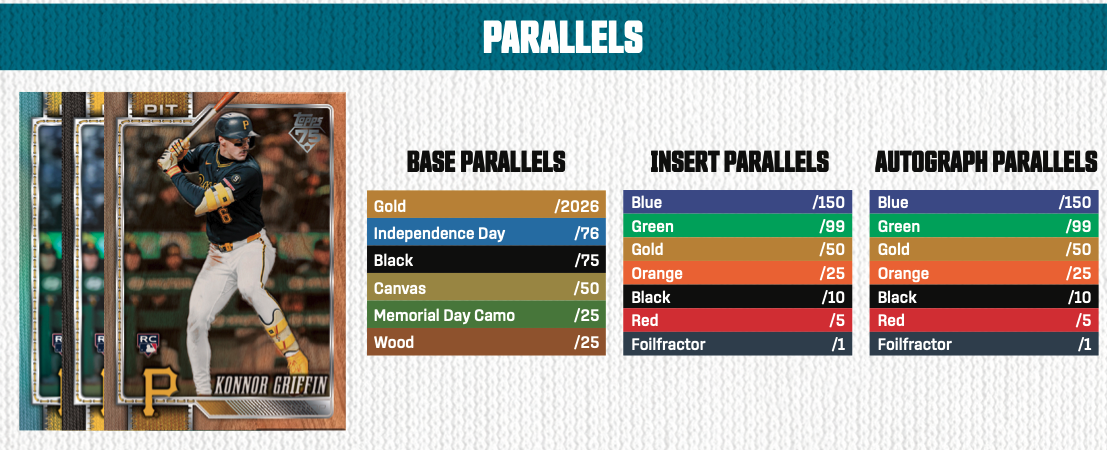
Many autograph and relic serial runs vary by subject or are published as a maximum (“or less”). These are not displayed as an exact run for every card. Base Gold has conflicting references: Topps’ current guide says /249 while secondary catalogs say /275. Its exact denominator remains unclaimed. Other researched serial evidence is retained with the import records.
X checklist PDF · Ginter X odds PDF · Topps product page · X parallel reference
The 1,226 checklist entries include 50 greetings, 20 musical items, baseball subjects and celebrity signatures. Words & Languages shows each greeting with its language; Musical Methods groups listening and music items; People & Celebrities groups non-baseball people. These browse groups have no MLB division. Printed affiliations such as Penn State are preserved as card details without assigning an MLB franchise. Only X-specific parallels are imported; regular Allen & Ginter relics, rip cards and parallel ladders are not carried over. Autograph serial numbers are unknown or signer-specific, so they are not called universally unnumbered.
Unknown serial runs remain unknown in odds filters. Original PDF labels, source pages, file hashes, corrections and research links are retained in the reproducible import records. The SSP filter uses the same Savvy rare-insert policy described below; color parallels alone do not qualify.
The starter product contains 890 card designs from Topps’ supplied checklist, including 200 base cards. There are 30 MLB franchises plus a separate non-team group for 17 astronaut and scientist cut signatures. Dual and triple cards retain all named subjects and printed teams. Historical teams map to their current franchise for browsing.
Manufacturer checklist PDF · Manufacturer Hobby / Lunar odds PDF · Topps collector guide · Parallel serial reference
Parallel availability is mapped at the card-family level from the odds sheet. Topps cautions that inclusion of a subject does not guarantee every parallel. Pack odds are set-level pull rates, not the odds of pulling a particular player. Hobby is verified at 20 packs of four cards; Lunar box configuration is unverified, so Lunar per-box estimates are omitted. Autographs are randomly inserted.
Rookie status follows the base checklist when available. Explicit corrections remove rookie labels from veterans mistakenly marked on multiplayer cards, and apply the verified rookie identity to Supernova cards missing a printed rookie label. Original labels are retained in the import records.
The SSP filter is a Savvy-curated rare-insert grouping: non-autograph insert families whose best published pull rate is at least 1 in 500 packs across every offered format. It is not an official Topps SSP designation or a guaranteed case hit. Numbered color parallels are not automatically SSPs. Supernova is a Hobby chase but is excluded from this filter because its Lunar odds are 1 in 77 packs; it remains available under Chase Inserts.
These counts describe the corpus itself, so they grow as new products are loaded. The dated figure above is the most recent checklist ingest, taken from the database’s own processing log — never a page-load timestamp.
Almost every counting question on the hobby comes down to which of two units you mean. The site labels both explicitly and never silently swaps one for the other.
A worked example: in 2026 Topps Cosmic Chrome Baseball, Shohei Ohtani’s base card is #1. That single card number is catalogued in dozens of parallel versions — the base card, Refractor, Nucleus, White Hole and numbered Refractors down to a one-of-one. That is one base card and many card appearances. Both are true; they answer different questions.
Unique identities use the checklist's card identity, shared by its parallel versions. Where that identity is missing, we use the subject, card number and recorded set grouping (or full set name). A card filed under several teams appears in each team checklist but counts once in the product's unique-card total. Team totals therefore need not add up to the product total.
On a product page you will see both, side by side and labelled, precisely so a parallel-inclusive total is never mistaken for the base-card count.
Some figures count people and some count cards. Mixing them is the single most common way hobby stats mislead, so the site keeps them apart and names them accordingly.
Below each product checklist is a short list of analytical statements. These are generated deterministically from that product’s own checklist and compared against the other products in the same season — there is no prose template with interchangeable adjectives and no language model writing them. Every statement is reproducible from the database.
0 means cards are spread evenly across teams; a higher value means a
few teams dominate the checklist.A comparative claim (“the deepest parallel structure,” “the most evenly spread”) is only made when a product actually sits at an extreme of its season. A middle-of-the-pack product gets the bare fact with no superlative, because the ranking wouldn’t be meaningful.
Checklists come from publicly released manufacturer checklists and product documentation — spreadsheets, PDFs, and CSV exports — reformatted into one common structure and loaded into a single database so every product can be queried the same way. Box and pack odds are loaded separately from the odds sheets Topps publishes, and only exist for products where those sheets exist. The site never estimates odds a manufacturer has not released.
Data is refreshed when an official checklist is released or revised, when corrections are found, and when missing team, player, or card assignments are filled in. The “last ingested” date above reflects the newest content in the database. For the full rules on how cards are filed under franchises (throwbacks, relocations, multi-player cards, and college teams), see the About & Methodology page.
These counts describe what is on the checklist, not what is in a box. Print runs, pack odds, and distribution decide what actually comes out, and only the manufacturer publishes those. Savvy Collecting is a research tool, not a price guide, and it does not promise what you will pull. For buying, selling, or breaking decisions, verify the current official manufacturer checklist and odds as well.
Savvy Collecting is an independent resource and is not affiliated with Topps, Panini, Fanatics, the MLB, MLBPA, eBay, or any manufacturer, team, player, or marketplace. See the Disclaimer and Affiliate Disclosure for detail.